


Shaping the Future of Financial Services
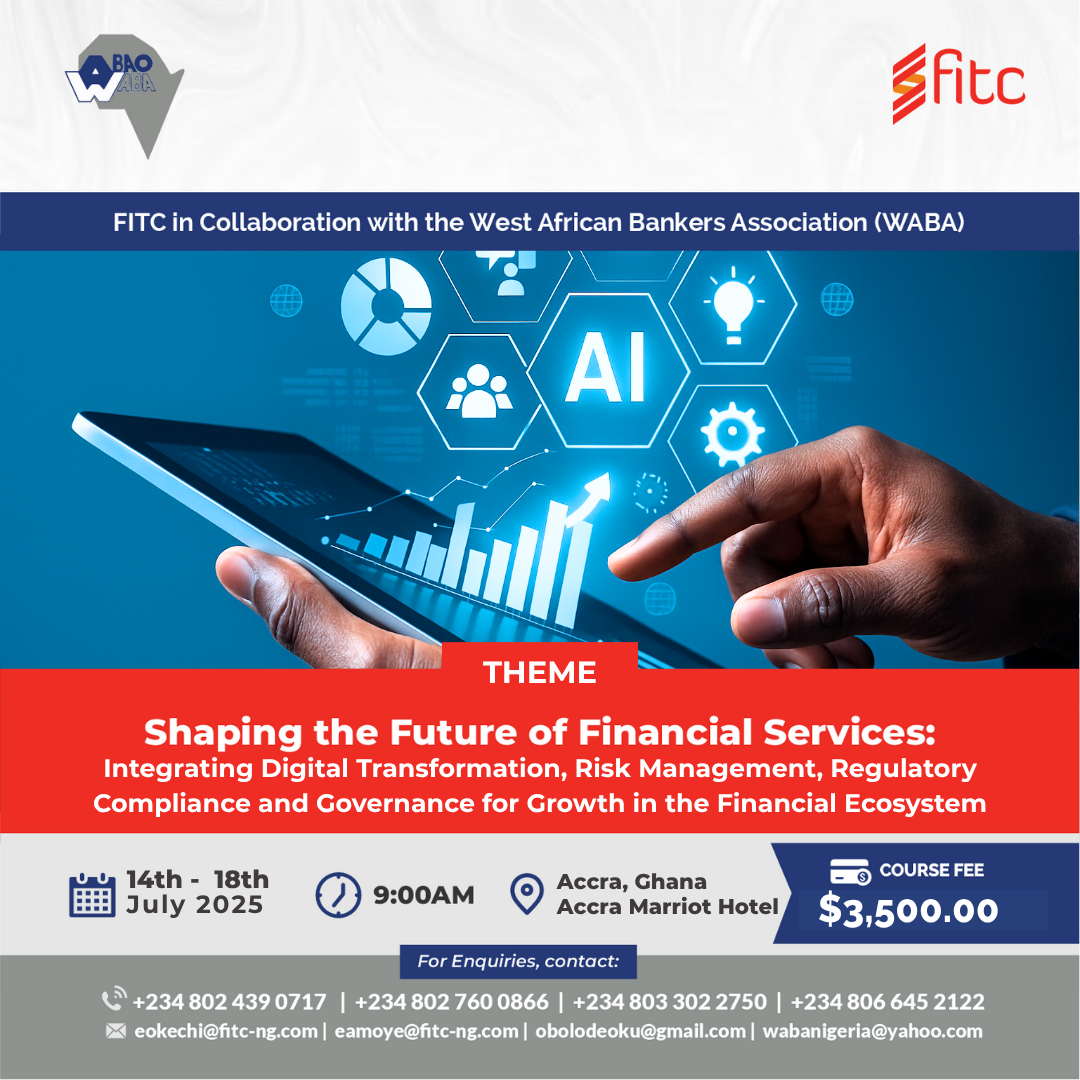
FITC in Collaboration with the West African Bankers Association (WABA) Presents
Shaping the Future of Financial Services: Integrating Digital Transformation, Risk Management, Regulatory Compliance and Governance for Growth in the Financial Ecosystem
Date: July 14-18, 2025 Venue: Accra, Ghana
Background
The financial services landscape across Africa is undergoing profound disruption, propelled by the accelerated pace of digital transformation, the emergence of fintech innovations, and growing consumer expectations for seamless, secure, and inclusive financial solutions. For West African financial institutions to remain competitive, resilient, and future-ready, Board members and senior executives must strengthen their strategic oversight capacities by aligning their institutions with emerging technologies such as AI, blockchain, digital identity, and open banking. These shifts demand not just operational agility, but strategic foresight and a fundamental redesign of governance models to manage evolving risks and opportunities in the digital financial ecosystem.
At the same time, heightened regulatory scrutiny and evolving compliance expectations driven by regional and global standards on AML-CFT-CPF, data privacy, cyber risk, and sustainability are compelling Boards and executives to rethink traditional compliance frameworks. Regulatory bodies are placing increasing emphasis on proactive risk governance, robust internal controls, digital resilience, and ESG-aligned conduct. Therefore, financial leaders must cultivate a dynamic governance culture that integrates compliance into enterprise-wide strategies while fostering innovation, ethical leadership, and long-term value creation.
Therefore, it is against this backdrop that FITC, in collaboration with the West African Bankers Association (WABA) is excited to present the 2025 flagship partnership programme, titled, “Shaping the Future of Financial Services: Integrating Digital Transformation, Risk Management, Regulatory Compliance and Governance for Growth in the Financial Ecosystem“. This high-level WABA and FITC programme is purposefully designed to equip Board members and Senior Executives with critical insights, practical tools, and peer-led perspectives to navigate these complex intersections. Also, the Senior Leaders will be empowered through the special programme to drive sustainable growth, strengthen institutional resilience, and reshape their organisations’ role within an increasingly interconnected and regulated financial ecosystem, by exploring frontier issues such as supervisory technology (SupTech), RegTech adoption, digital ethics, and cross-border regulatory alignment. Ultimately, the programme aims to future-proof West Africa’s financial services sector through integrated leadership and governance excellence.
Target Participants
- Board Chairpersons and Non-Executive Directors of banks, insurance companies, pension funds, and other financial institutions
- Managing Directors/Chief Executive Officers (MD/CEOs) of regulated financial institutions and Fintech firms.
- Executive Directors and Deputy Managing Directors oversee strategy, risk, operations, and innovation
- Chief Risk Officers (CROs) and senior risk management executives
- Chief Compliance Officers (CCOs) and Heads of Regulatory Affairs
- Chief Information Officers (CIOs) and Chief Digital/Technology Officers are responsible for transformation
- Governance Executives and Company Secretaries providing board advisory support
- Heads of Internal Audit, Strategy, and Finance are involved in enterprise oversight
- Senior Officials from Central Banks, Financial Regulators, and Supervisory Agencies involved in policy and regulatory reforms
Learning Outcomes
- Strengthen Board and executive capacity to oversee digital innovation, assess emerging technologies, and align transformation initiatives with institutional growth and competitiveness.
- Develop the ability to anticipate and govern complex, technology-driven risks, including cyber threats and systemic vulnerabilities, through integrated enterprise risk management frameworks.
- Gain critical insight into evolving regulatory landscapes and supervisory expectations, enabling more effective board-level oversight of compliance, data governance, ESG mandates, and cross-border regulatory obligations.
- Foster high-impact leadership, ethical stewardship, and agile governance models that promote institutional resilience, stakeholder trust, and long-term sustainable growth within the financial services ecosystem.
Learning Objectives
- Evaluate the strategic implications of digital transformation, emerging technologies, and fintech disruption on institutional sustainability, competitiveness, and business model evolution.
- Apply integrated risk governance frameworks to assess, mitigate, and oversee digital, cyber, operational, and third-party risks in a rapidly evolving financial services environment.
- Interpret and respond to emerging regulatory and compliance trends—including AML/CFT, cybersecurity, ESG reporting, and digital financial regulation—to strengthen institutional compliance posture.
- Assess the effectiveness of board governance structures and decision-making processes in driving ethical leadership, digital trust, and long-term stakeholder value.
- Formulate actionable strategies that align digital innovation, regulatory compliance, and enterprise risk management with sustainable institutional growth and systemic financial stability.
Programme Outlines
DAY 1: Navigating the New Frontier – Digital Transformation and Innovation in Financial Services
Theme: Africa’s Financial Future – Boardroom Leadership in a Digitally Disrupted World
Modules: Harnessing Digital Transformation at the Board Level
- Aligning digital strategy with institutional mission
- Board oversight of AI, blockchain, open banking, and platformisation
- Digital-First Governance: Ethics, Oversight, and Trust in Technology Adoption
- Governing digital disruption responsibly
- Ensuring ethical use of AI and customer data
- Case Study – Leading Digital Change in a Pan-African Financial Institution
DAY 2: Risk Management Reimagined – Building Digital Resilience and Enterprise-Wide Risk Intelligence
Modules: Integrating Digital and Cyber Risk into Board Risk Appetite Frameworks
- Risk dashboards and key risk indicators for digital ecosystems
- Governance of cyber resilience and third-party risk
- Operational Risk, Systemic Vulnerabilities, and Business Continuity in the Age of Fintech
- Scenario planning, stress testing, and systemic resilience
- Regulatory technology (RegTech) and supervisory technology (SupTech) in risk intelligence
- Board Simulation Exercise: Responding to a Major Cybersecurity Incident
DAY 3: Regulatory Alignment – Compliance Oversight and Global Regulatory Convergence
Modules: The Role of the Board in Strengthening Compliance Culture and Regulatory Engagement
- AML/CFT, data privacy, and ESG compliance
- Cross-border regulatory trends and cooperation
- Supervisory Expectations and Board Accountability in a Complex Regulatory Era
- Emerging guidelines from central banks and global standard setters
- Practical tools for regulatory reporting and disclosures
- Expert Fireside Chat: Regulators’ Roundtable – Aligning Supervisory Mandates with Innovation
DAY 4: Governance for Impact – Leading with Purpose, Agility, and Accountability
Modules: Building Agile Governance Structures for the Future
- Board effectiveness, renewal, and digital readiness
- Metrics for governance performance and ESG integration
- Strategic Foresight and Scenario Thinking for Financial Boards
- Leading through uncertainty and complexity
- Future-proofing strategies for inclusive and sustainable growth
- Peer Review Session: Boardroom Scenarios – From Compliance to Competitive Advantage
DAY 5: Executive Industry Tour – Accra, Ghana
|
Duration: 5 Days |
Arrival (Check in at Hotel): Sunday, July 13, 2025
Departure (Check out): Saturday, July 19, 2025 |
|
Methodology |
Classroom-style lectures, syndicate sessions, role-plays, relevant case studies, and study tours. |
COURSE FEE
$3,500.00 (Three Thousand, Five Hundred Dollars.) (This fee covers tuition and full course documentation, but EXCLUDES Accommodation, Air fare and other travel costs).
Refund of Fee: Fees paid for participants who do not turn up will be refunded, subject to a 25% administrative cost deduction.
Sales Promotions & Discount Offerings
|
Take Maximum Advantage of the Special Offers for Your Amazing Organisations: |
|||||
|
S/N |
Sub |
Descriptions |
|
Discounted Amount ($) |
Amount to Pay ($) |
|
1 |
|
Early Bird Registration for the programme ends on Tuesday, June 16, 2025 |
|
|
|
|
|
a |
Early Birds discount: 7.5% |
|
262.5 |
3,237.50 |
|
|
|
|
|
|
|
|
2 |
|
Additional Quantity Discounts Apply: |
|
|
|
|
|
a |
20% discount benefit applies to organisations with ten (10) or above nominations for the programme |
|
700 |
2,800.00 |
|
|
b |
10% discount benefit applies to organization with six-nine(6-9) nominations for the programme |
|
350 |
3,150.00 |
|
|
c |
7.5% discount benefit applies to organisations with four-five4-5 to) nominations for the programme |
|
262.5 |
3,237.50 |
|
|
d |
5% discount benefit applies to organisations with three (3) nominations for the programme |
|
175 |
3,325.00 |
Account Details
|
Account Name |
Bank Name |
Account Number |
Sort Code |
Swift Code |
|
Financial Institutions Training Centre |
GT Bank |
0129551101 |
058-152052 |
GTBINGLA |
|
|||


