

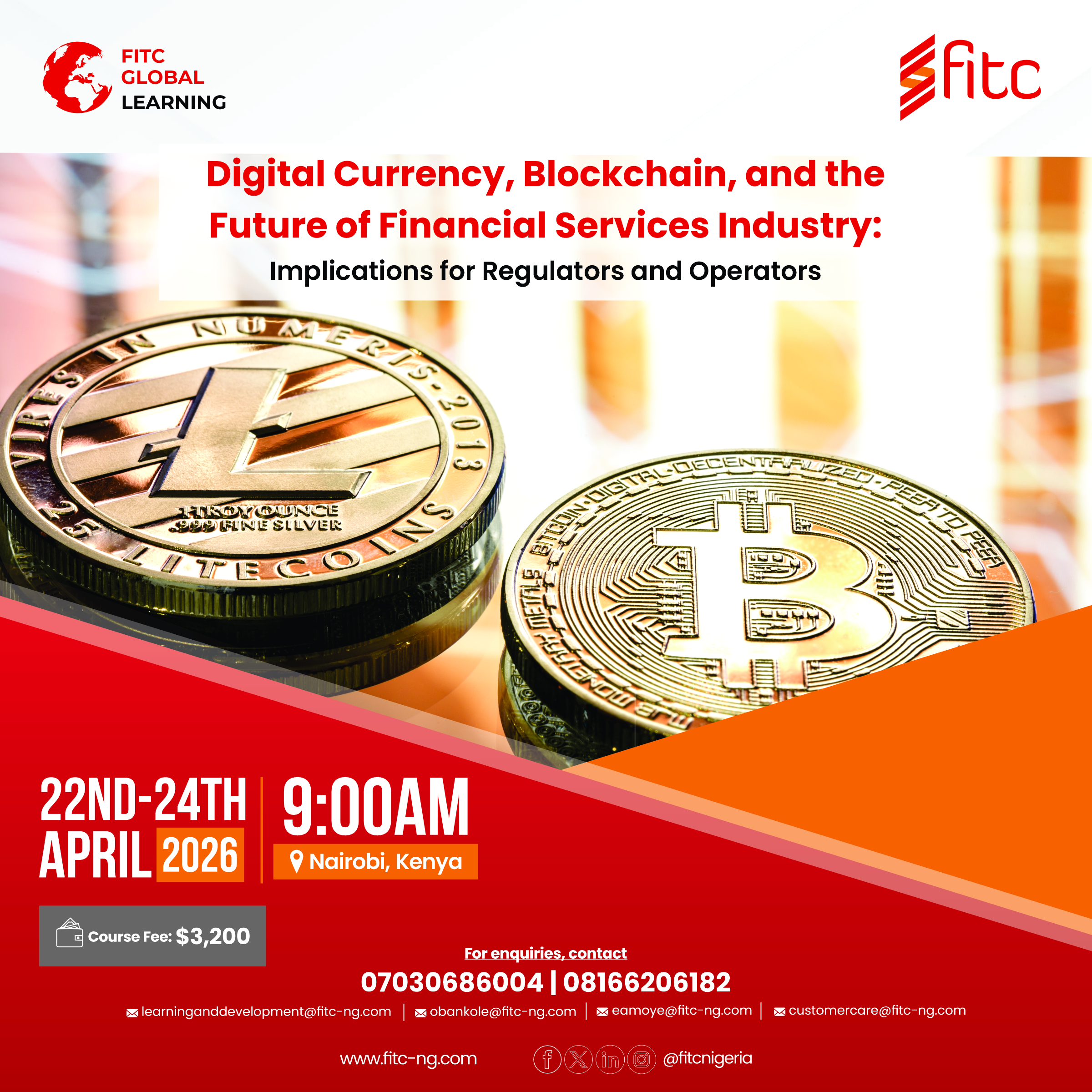
Digital Currency, Blockchain, and the Future of Financial Services Industry: Implications for Regulators and Operators
Background
The financial services industry is undergoing a fundamental transformation driven by the rise of digital currencies and blockchain technology. What began with cryptocurrencies challenging traditional notions of money has evolved into a broader re-examination of how value is created, stored, transferred, and regulated. Digital currencies now extend beyond speculative assets to include central bank-led initiatives such as Central Bank Digital Currencies (CBDCs), which aim to modernise legal tender while improving payment efficiency, inclusion, and monetary policy effectiveness.
Blockchain technology sits at the core of this evolution, providing a decentralised and cryptographically secure infrastructure for recording and validating transactions. Its attributes- transparency, immutability, and resilience- have enabled new financial use cases such as smart contracts, asset tokenisation, faster settlement systems, and alternative financing models. These innovations have the potential to significantly reduce operational inefficiencies, lower transaction costs, and unlock new sources of value across the financial ecosystem.
For regulators, the emergence of digital currencies and blockchain presents both opportunity and complexity. Traditional regulatory frameworks, built around central intermediaries and jurisdictional boundaries, are being tested by decentralised networks, near-instant cross-border transactions, and new categories of digital assets. Regulators are therefore required to strike a careful balance between encouraging innovation and safeguarding financial stability, consumer protection, market integrity, and the prevention of illicit financial activities, often through adaptive, technology-enabled supervisory approaches.
For financial institutions and market operators, these developments create strategic imperatives. Digital currencies and blockchain offer pathways to enhance product offerings, improve operational efficiency, and remain competitive in an increasingly digital economy. However, realising these benefits requires robust governance, investment in technology and skills, and close collaboration with regulators.
Given their inherent complexity and rapidly evolving nature, Digital Assets have elicited concerns as to their implications for consumer and investor protection, including issues about data privacy and security; financial stability and systemic risk; money laundering/crime; national risk; the ability to exercise human rights; and financial inclusion. With these concerns and the opportunity that digital currency and blockchain present, regulators and operators must work together to create a financial system for the African economy where traditional institutions, digital currencies, and blockchain-enabled platforms coexist, thus reshaping how finance is regulated, delivered, and experienced.
It is against this background that FITC is organizing a 5-day programme on Digital Currency, Blockchain, and the Future of Financial Services Industry: Implications for Regulators and Operators for regulators and operators who seek to navigate the future of finance with confidence and integrity.
Target Audience
This course is ideal for those who view digital currency not as a replacement for the financial system, but as the high-speed “rails” upon which a more inclusive, transparent, and integrated African economy is built.
- Central banks and financial regulators
- Supervisory authorities: NDIC, SEC, NDPA
- Executives in banks, payment service providers, FinTechs, and Development Finance Institutions
- Senior Professionals in the financial service industry who want to be Architects of the Future Finance
- Policy makers and financial infrastructure operators
- Data Scientists & AI Developers
- Legal and Compliance Officers in financial institutions
Learning Outcomes
- Understand the underlying technology powering digital currencies
- Develop strategic insight into CBDC design models and trade-offs
- Assess regulatory, supervisory, and systemic risk implications of digital currencies and blockchain
- Build appropriate structures and establish best‑practice approaches to regulating digital currency ecosystems.
- Design transformation roadmaps for institutions and regulatory bodies
Learning Objectives
- Explain the foundational technological and economic forces driving digital currency adoption.
- Evaluate the rise of CBDCs and implications for monetary systems
- Examine the strengths and limitations of digital currency and blockchain relevant to regulatory and operational contexts
- Explore risk‑based regulatory tools to support innovation while protecting the system.
- Support regulators and operators with a blueprint for safe and effective oversight
Programme Content
- Overview of Digital Currencies and Emerging trends
- Money: from physical cash to programmable money
- Digitisation of financial services
- Emergence of digital currencies
- Evolution of payment systems and financial market infrastructures
- Drivers of digital currency adoption (efficiency, inclusion, geopolitics)
- Role of trust, intermediaries, and central banks
- Emerging trends in the development of Digital currencies in other jurisdictions; USA, Japan, South Africa, The Caribbean, Ghana.
- Blockchain and Distributed Ledger Technologies (DLT)
- Definition of Blockchain
- Blockchain fundamentals: public vs private, permissioned vs permissionless
- Consensus mechanisms (Proof of Work (PoW), Proof of Stake (PoS), BFT models)
- Smart contracts and tokenisation
- Interoperability, scalability challenges, and governance trade-offs
- Cryptocurrency Ecosystems and Market Structure
- Bitcoin, Ethereum, stablecoins, altcoins
- Token classifications: payment, utility, security, governance
- Crypto exchanges, wallets, miners, node operators, validators
- Lending, staking, yield markets
- Market manipulation and integrity issues
- Risks: volatility, liquidity, custody, cybersecurity
- Central Bank Digital Currencies (CBDCs) and Stable Coins
- Retail vs. wholesale CBDCs: Implications for financial stability, bank disintermediation, and monetary policy transmission
- Motivations for CBDCs: financial inclusion, efficiency, control, geopolitics
- Design choices: account‑based vs. token‑based
- CBDC architecture options: direct, hybrid, intermediated
- Case studies: China, EU, Nigeria (eNaira), Bahamas, etc.
- Implications for commercial banks and payment operators
- AML/CFT compliance in CBDC ecosystems
- The Stablecoin Ecosystem: Exploring collateralization models (Fiat-backed vs. Algorithmic) and the systemic risks of Tether (USDT) and Circle (USDC)
- Decentralised Finance (DeFi) and Embedded Finance
- DeFi protocols: lending, exchanges, staking
- Embedded finance and platformisation
- Role of smart contracts in financial intermediation
- The Convergence: How incumbents (Goldman Sachs, J.P. Morgan) are integrating DeFi protocols into traditional capital markets
- Digital Assets, Tokenization, and the Future of Capital Markets
- Asset tokenization (equities, bonds, real estate, commodities)
- Security tokens and regulatory classifications
- Decentralized finance (DeFi): platforms, protocols, risks
- Automated market makers (AMMs) and decentralized exchanges
- Tokenized money market funds and digital bonds
- Impacts on liquidity, settlement cycles, and market efficiency
- Risk, Stability, and Financial Integrity
- Financial stability risks of digital assets
- AML/CFT challenges in crypto ecosystems
- Travel Rule and transaction traceability
- Cyber risk and operational resilience
- Risks in DeFi
- Case study – FTX collapse: regulatory and supervisory lessons
- Risk-based AML/CFT Approach to Digital Currencies
- Risk based approach to AML/CFT in the Virtual context
- The scope of the FATF Standard and the application of the standard on countries of competent authoroties
- Application of the FATF Recommendations to convertible virtual currency in the context of VCPPS
- Updated FATF guidance for a risk-based approach to virtual assets and virtual asset service providers (VASPs)
- Listed activities under the FATF Recommendation, the travel rule requirement
- Recommendation 15 of FATF for global AML / CFT Standards for virtual assets and VASPs.
- The implication of the FATF Risk-based AML/CFT standard on regulators and supervisors
- 9. Regulatory and Supervisory Frameworks and Global Standards
- Principles-based vs rules-based regulation
- Global emerging frameworks (FATF, BIS, IOSCO, IMF)
- AML/CFT compliance in digital finance
- Licensing regimes: VASPs, exchanges, custodians, stablecoin issuers
- Prudential and market integrity considerations
- Evaluating the Investment Securities Act (ISA) 2025; EU MiCA, UK FCA, MAS framework
- Cross-border coordination and regulatory harmonisation
- Consumer protection frameworks
- Data privacy and cybersecurity obligations
- Sandbox and innovation-friendly regulatory approaches
- 10. Payment Systems Innovation and Digital Financial Infrastructure
- Evolution of domestic and cross‑border payments
- Role of fintechs, super‑apps, card networks, and new digital banks
- Blockchain-based payment rails
- Interoperability with legacy systems (RTGS, ACH, card schemes)
- Role of digital identity and KYC innovations
- Open banking and APIs in digital currency ecosystems
- The Future of the Financial Services Industry
- Convergence of AI, blockchain, IoT, quantum computing
- Tokenized economies and programmable money
- Future of banking, insurance, and capital markets
- The geopolitics of digital currency and global power shifts
- Regulatory innovation and cross‑border cooperation
- Strategies for banks, FinTechs, and regulators
Field Visits & Experiential Learning
Participants will gain real-world exposure through curated visits and engagement sessions in Nairobi


